Thursday, November 7, 2013

Suzanne Valadon - Redefining Sexy

Suzanne Valadon
"She was conceived and delivered in disgrace"(www.suzannevaladon.com). For this post, I decided to focus on a painter that in my opinion, made a true effort to challenge what was considered normal in fine art. Suzanne Valadon was born the illegitimate daughter of a laundress in France. Society dictates at the time that being a single mother with a child is not a good thing, specifically in Europe. But, that can be said anywhere. Suzanne had no choice but to earn her keep at a very young age. At the age of nine she started training to become a trapeze artist. However, an accident stopped that pursuit. She later became an artists' model. She posed for such acclaimed artists as Pierre-Auguste Renoir and Henri de Toulose-Latrec (www.nmwa.org). It is here that she learned some techniques as a muse for the important artist of her time. Also, her unique experience as a model initially gave her a perspective that no male artist could ever have. She could not only paint from the point of view of the eventual male viewer, but also from the intricate angles that only an artist model can know. Chadwick states, "Valadon's female nudes fuse of the female body based on he experience as a model" (Chadwick 285).

Grandmother and Young Girl Stepping
into the Bath (c.1908)
"Valadon became an artist's model...she was part of the sexually free Bohemian life of early twentieth-century Paris"(Chadwick 283). This was beneficial to her as an artist in terms of education and in some ways notoriety. At the time, as with every other major or minor art movement, the concept of a woman calling herself an artist by profession was nowhere near accepted in society, especially in Europe.But, the region Valadon was in gave her the chance to paint what she wanted. She was most known for depictions of the female nude. She painted them extensively due to her interest in sexuality. She broke the mold by painting females that were intended to be sexy. This was not the norm among the few women painters during this time. So, we learn early that breaking new ground is something of a hobby to her. What she did differently from her male and female predecessor was make make the settings of her pieces more believable and more domestic. As Chadwick states, "Valadon often placed her figures in specific domestic settings, surrounding them with images of domesticity and community as in Grandmother and Young Girl Stepping into the Bath (c. 1908)" (Chadwick 285-286). This can be seen in the previous piece mentioned along with one of her more well know pieces, The Blue Room (1923).
The Blue Room (1923)

"Rejecting the static and timeless presentation of the monumental nude that dominates Western art, she emphasizes context, specific moment, and physical action. Instead of presenting the female body as a lush surface isolated and controlled by the male gaze, she emphasized the awkward gestures of figures apparently in control of their own movements" (Chadwick 285). When put in comparison to Tintoretto's Susanna and the Elders, the different interpretations on female sexuality is pretty obvious. The colors are more vibrant and gripping in Valadon's piece, making it a little more difficult to realize the focal point of the piece. Also, in more obvious findings, she's clothed. When looking at Tintoretto's piece, the female is brightly lit and nude. She is depicted in a way, along with the secondary and tertiary components, to be the object of sexual desire and completely accepts it. Valadon does the same, but the way she is drawn does not scream out sex. It actually questions the conventions of what sexy is supposed to be. It forces the male viewer to either redefine sexy, or reject all sexual desires altogether. That's genius! In a time where the female figure is only seen as an object, to almost completely reject the tried and true practices and customs of the "great" artists that came before her is paramount. 
Susanna and the Elders (1555)

Judy Chicago's: The Dinner Party
(1974-1979)
Valadon had a lasting impression on the art world in more ways than just attempting to redefine what sexy is. The subject matter that she worked primarily in was a first among almost all female artists. "Valadon and Modersohn-Becker were two of the first women artists to work extensively with the nude female form. Their paintings collude with, and challenge, narratives that construct female identity, through connections to nature, and that view of women as controlled by emotions, sexual instincts, and biology" (Chadwick 282). The most amazing thing is that these innovations came from the hands of female. What? To be honest, with the way art history has been recorded and credited up to this point, I thought that a male artist would be given full responsibility for such innovations. This in a way inspired some artists of today to sort of shake things up. Groups like the Guerrilla Girls and other innovative female artists like Judy Chicago could have been influenced by the actions of Valadon. Maybe not in style, but in action. Valadon could have been one of the artists that gave others the courage to more females to challenge the norm. Thus creating innovative art that is not only aesthetically pleasing, but issue based.
Suzanne Valadon did more for the women in the art world than she gets credit for. From an upbringing that was frowned upon by everyone, to critically acclaimed, definition defining artist. Suzanne Valadon quite literally came from the bottom to the top. Well, at least for a woman at the time. She got people to notice that she is more than just a pretty face. 

Works Cited
Chadwick, Whitney. Women, Art, and Society. London: Thames & Hudson, 2007. Print.
"National Museum of Women in the Arts." Suzanne Valadon. N.p., n.d. Web. 07 Nov. 2013. <http://www.nmwa.org/explore/artist-profiles/suzanne-valadon>.
"Satie and Suzanne (whole Movie)." YouTube. YouTube, 01 Sept. 2012. Web. 07 Nov. 2013. <http://www.youtube.com/watch?v=BBCk1RkAYaU>.
Sonia Delaunay


Sonia Delaunay wearing one of her owned desings

             Sonia Delaunay was a 20th century artist who had inspired many women, not only female artists or artists in general but also those the women that besides all the home labor that needs to be done especially for the ones that are mothers and devoted wives. There are types of women that share a commom professional career just like Delaunay who had a really busy scheduled as we all do. As the Guerrilla Girls confirm with Sonia owned words " I have led three lives: one for Robert, one for my son and my grandsons, a shorter one for myself. I dont regret not having given myself more attention. I really didnt have time" ( 61).

           As a big fan of patterns and colors, Delaunay became one of my favorites for her enormous passion for color and shapes. Delaunay was a painter and a fashion designer. As Chadwick stated in her book " During the years when Omega was active, ease of movement and primacy of color as expressive medium also characterized Delaunay's work in both painting and decoration" (260). She used geometric shapes in her work. Also, she was interested in patterns of surface design. Moreover, her work is characterize by her used of different shapes in her paintings as well in her designs. She wanted to communicate with materials. Her specialization was textiles and embroidery.


            Delaunay Background influenced her work. She was born in Ukraine and in a working class Jews family were she lived to the age of five. One of her family members, her uncle who was a professional wanted to adopt her. Mrs. Delaunay's financial life progressed once she moved with her uncle. She went from a working class in a small town in Russia to where he lived. She was educated and had a good position and enjoyed some advantages that other women didn't have at that time. She obtain a stronger personality and independent wealth. She was studying art in Germany. However, she was independent women who wanted to able to make decisions for her own future. She decide to stay in Paris and determined to stay there found a way to stay by marrying a friend. Delaunay arranged the marriage of convenience. She actually began with her art exhibition in her  husband's gallery. However, she divorced her husband and married a progressive artist, Robert Delaunay, who she felt deeply in love. The fruit of this love gave her a son. Delaunay, was a women who didn't stay in once place she actually moved and encounter different cultures. One of her famous paintings is Simultaneous Contrast, 1912 " reveals an interest in the dynamics of surface design which then became her primary concern" ( Chadwick, 261).

                                                Sonia Delaunay Simultaneous Contrast 1912
http://paintings-art-picture.com/paintings/archives/1618/sonia-delaunay-terk-simultaneous-contrasts-1913

However, Delaunay's passion for painting was given away for the interest of her husband as many women do today. Chadwick quotes Sonia words " From the day we started living together, I played second fiddle and I never put myself first until the 1950s"(p.261).

            Delaunay was a fantastic designer. Women wore her designs and she wore them as well. Chadwick points out about Delaunay " dissatisfied with the inherently static qualities of painting as a medium, during the Summer of 1931 Delaunay began to make simultaneously dresses, in reaction against of drabness of current fashion"(262). At that time, Women showed a type of independence. Liberation was a new formed to express their freedom of their body, expression and motion. Women could wear something shorter, completely different from 20 years earlier. Women used to wear corsets, long dresses, and even the way how they were supposed to walked was restricted. Moreover, women were supposed to act in a certain way at that time. However, things started to change about their clothes which became more comfortable for women. Paris was the center of fashion and took a lead in this new concept of women. There was definitively a  transformation in the image of women. During the First World War when all of the men were to war women began to work in factories and other places.There was a type of accommodation in women clothing especially now that women need to run around. There was a need for something loose and comfortable to have more flexibility. There was a emerge for the production of fashion and all the things that women like to buy. Chadwick quoted " Russian art in the years before the Revolution of 1917 developed along two broad paths. While some artist worked primarily in two dimensions, others emphasized construction, texture, and design" (264). By that time  the artist were influenced by" Nepromitivism, Cubofuturism, Rayonism, Suprematism, and Constructuvism" (Chadwick, 264).
               Delaunay became a successful business women. In Paris, she produced fashion designs, accessory designs and expanded to textile designs. She also gives space between the colors where the abstract of light is present. Before the first world war, there was the phenomenon of  made of choreographic that included folk dances. She has a friends who was her favorite designer from the Ballet Russe in Paris who incorporated colors and patterns. Delaunay had a beautiful house whose interior was design by her. She even made a baby quilt for her son. This was Delaunay's " first piece of decorative art, and first completely abstract work " (Chadwick, 260).


Sonia Delaunay Couverture 1911 

 The ideal of quilt let Sonia to get to abstraction. She presented in her work abstracts of light. Her husband was also painting in this period and became famous. The both were working in the same time. They are working with intense colors. However, Sonia liked to experiment with her work. Instead of work with black that was a representation at the begining of the First World War she decided to work with bright colors.  Sonia and her husband traveled. After the Russian Revolution took place and she lost all of her income. They were in Spain broke by that time. She opened a boutique in Madrid and was selling objects. She met new some aristocrats who she was able to sell her work. Delaunay  made the costume for Cleopatra for the "Diaghilev's Ballets Russes" in Paris.


 Sonia Delaunay costume for Cleopatre with Chernichova in the title-role,1918.
http://zolotoivek.tumblr.com/post/17842894967/lyubov-tchernicheva-wearing-a-costume-designed-by
This was an important event for Delaunay. Scarves were important in her work ,too. There was a tremendous rate for scarves. There was a mode from open flat surfaces as a fashion form. Even dresses were made of scarves. There was charity events for funded raiser for the Russian refuges were Sonia Delaunay joined and she was actually ask to do the fashion for the funding raised ( Chadwick 260-278). 

              In overall, Sonia Delaunay showed to be a brave women and even though she put her passion for painting away for her husband's benefit she continued later on as many women did in the past decades and still do up until today. Women sacrificed everything for the wealth of the family as is dictate for the society. However, Delaunay became successful and her loved for colors and beautiful designs carried the image of the " New Women". (Chadwick, 278). This led Delaunay to become a famous fashion icon for this 21th century.


Work cited:
Chadwick, Whitney. Women, Art, and Society. New York, NY: Thames & Hudson Inc., 1990.
The Guerilla Girls. The Guerrila Girls' Bedside Companion to the History of Western Art. New York,                        NY:  Penguin Books, 1998. 


          During the 1930s Augusta Savage was an African American women artist, who was a sculptor during the 20th century. Savage was born on February 29, 1892, in Green Cove Springs, Florida, and original birth name was Augusta Christine Fells. Augusta died on March 26, 1962 in New York, New York. "Augusta Savage was one of the few visual artist involved in the  previous decade's cultural movement known as The Harlem Renaissance and one of the most influential artist working in New York's Harlem" (Chadwick 316). Savage  fought for African American artist like herself to be included in the organization called  "WPA". Besides fighting for the rights of African American artist, Savage "became an instructor at the WPA-supported Harlem Community Art Center and a major force in training of younger African American  artists" (Chadwick 316). 

           When we look at the 20th century in terms of societal conditions, we see a wide range of issues that are affecting America at this time. These inequalities included political, social, economic factors  America is still in the mist of a depression, making it hard for individuals like Augusta, who were of African American decent and faced a tremendous amount of discrimination. On top of all that Savage was a women artist sculpting during the time before the second World War, making it even harder to find a program to support her. But this did not stop Savage from seeking support from programs to help support her work. "A 1935 survey of professional and technical workers on relief revealed that among artists receiving aid,  approximately forty-one percent were women" (Chadwick 316)  and the program that supported the struggles of women during at that time was the "WPA". This precise organization helped Augusta in her struggles as an artist and funded her art. 
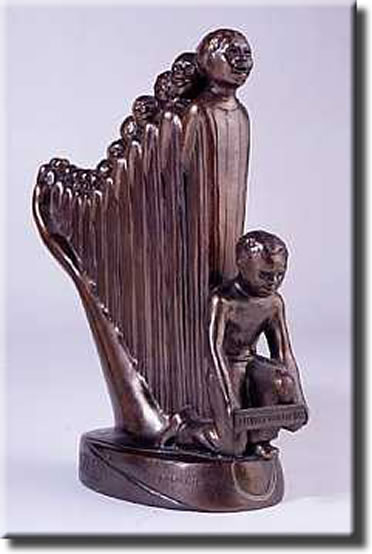
                                                                          "The Harp"
"The Harp" by Augusta Savage
http://www.1939nyworldsfair.com/worlds_fair/wf_tour/zone-2/the-harp.htm
         Augusta choose the mediums of expressing her art through the use of sculptures. Each of the numerous sculptures that she created, had its own significance at the time it was made. The picture above labeled "The Harp" was one of Augusta's more famous sculptures. Augusta was commissioned by the Works Progress Administration (WPA) to create a sculpture for the 1939 New York's World Fair. Augusta Savage's inspiration for this master piece came from "some of the lyrics of the poem "Lift Every Voice and Sing," she created "The Harp"(TBC 1). Many of the sculptures made by Augusta would depict many members of the African community  from ordinary people  to famous individuals. But all her work had some relation tying back to the African American community. In this one specific sculpture, Augusta depicts the face of two African Americans. The first one appears at the top of the harp strings, and the sound board of the instrument's has been transformed into a hand and arm. While the other is depicted kneeling, while holding music and offering it. This sculpture was  destroyed after the World Fair of 1939.

          Another famous piece by Augusta in which she express through her creative sculpting skills was the "The Pugilist" shown that the bottom. In this sculpture we see that Savage has again chosen to depict the upper half of an African American male. In this painting we see "The Pugilist" confronts the world with his head tilted upward and arms folded ready to take any challenge that his life will prsent him. "The statue also expresses the way that Savage shaped her personality. "The Pugilist" has a positive mood that symbolizes a strong person"(RCT).


"The Pugilist"
         Augusta savage will always be remember for her artistic works and  people in the community of Harlem remember "Augusta Savage as an artist, activist, and arts educator, serving as an inspiration to the many that she taught, helped, and encouraged."(TBC 1). Augusta was one the most influential artist that has ever work in Harlem. Savages artistic work and her teachings  will always have a lasting influence on contemporary artists. Augusta was a unselfish individual always looking to give back to her community and fight for the rights of her people. "I have created nothing really beautiful, really lasting, but if I can inspire one of these youngsters to develop the talent I know they possess, then my monument will be in their work." (T. R. Poston).

                                            http://www.youtube.com/watch?v=MyS3HPInHtI
                          This link above is the song that inspired Agusta Savage to Sculpt "The Harp" 


"Augusta Savage." 2013. The Biography Channel website. Nov 07 2013, 11:13http://www.biography.com/people/augusta-savage-40495.

Chadwick, Whitney. Women, Art, and Society. 4th. New York: Thames & Hudson, 2007. Print.
RC Templates, ed. Agusta Savage. Melissa Moxley, 8 Dec. 2011. Web. 7 Nov. 2013. 
     <https://sites.google.com/site/newdealartmuseum/gallery/agusta>.

T. R. Poston, "Augusta Savage,"Metropolitan Magazine, Jan. 1935, n.p"

The Erector of Sculptures

Louise Bourgeois
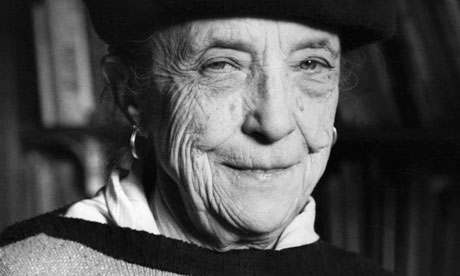
       When we look at the 20th century in terms of societal conditions, we see a wide range of issues that are counterintuitive to America being known as the land of opportunities and freedom. Many of the issues stemmed from the inequalities between men and women in the globally accepted societal structure of patriarchy. These inequalities were observed in the political, social, and economic realms and ones’ status, as well as freedom to act within each of the realms, was severely limited to whether the individual was a male or a female- females typically being the ones who experienced the short end of the “inequality stick.” One individual, however, managed to break the mold and lived a life relatively free of any restrictions or limitations in society and went on to become quite successful. Despite this individual’s relative lack of societal obstacles to overcome, she (yes, a female) based her art on the everyday problems that women would face as members of a patriarchal society as well as some of her own childhood experiences. This woman, as I would like to call her, is The Erector of Sculptures- Louise Bourgeois.

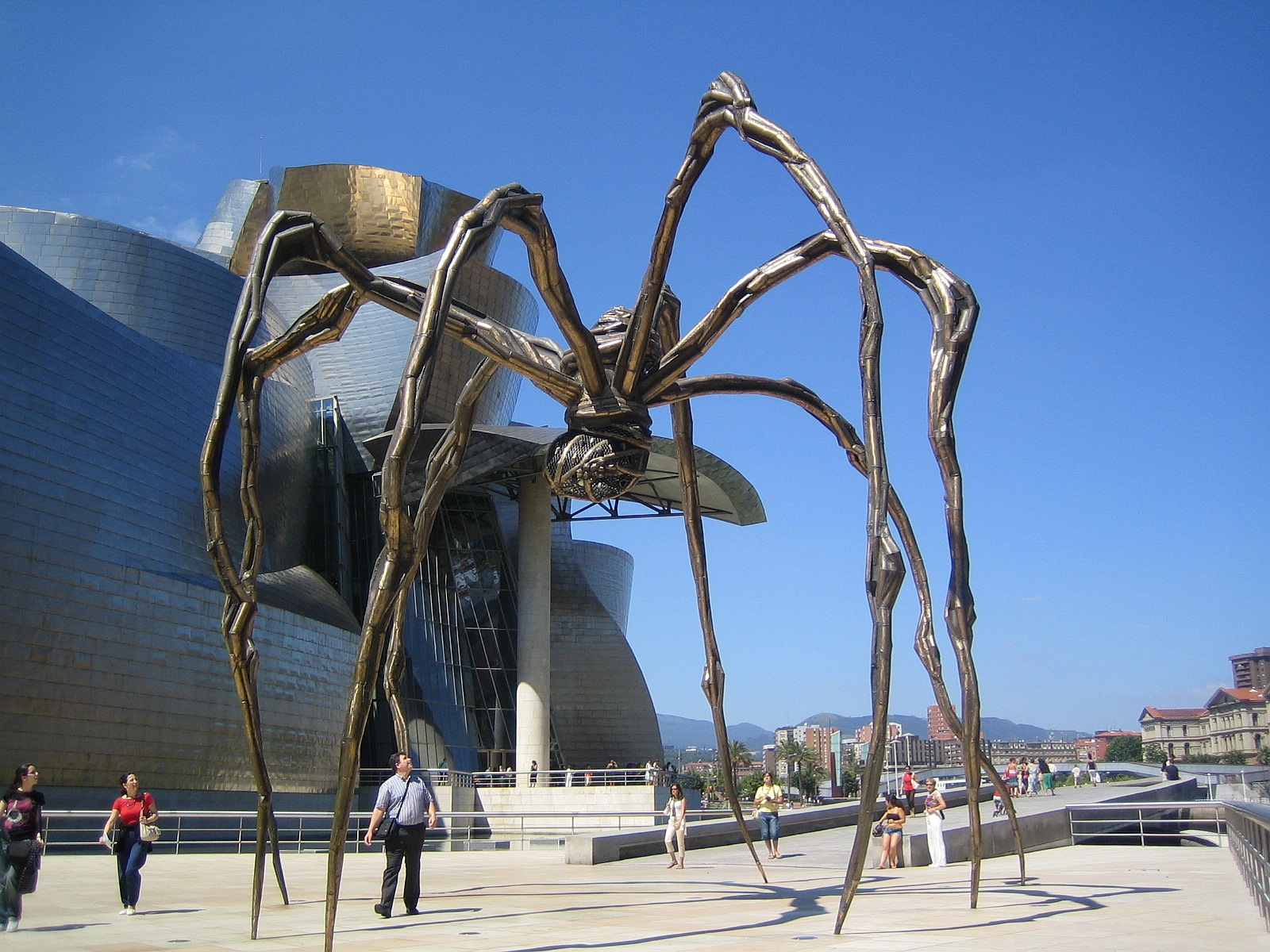
Maman, 1999 Louise Bourgeois
A sculpture at the Guggenheim that was
installed after the Guerrilla Girls advocated for
Louise's inclusion at the museum.
Almost like a gift to the world of art, Louise Bourgeois was born on December 25, 1911 in Paris, France. She was born to Josephine Fauriaux and Louis Bourgeois who happened to be artistically inclined and owned an antique tapestry gallery. It was at this point in time where Louise would come to fall in love with art and decide to pursue it as a career. Louise went on to study geometry at Sorbonne and art at a variety of institutions including Ecole du Louvre, Académie des Beaux-Arts, Académie Julian, and Atelier Fernand Léger to name a few (PBS, 2012). After her training, Louise went on to open her own print store within her father’s gallery where she sold her engravings and paintings. It was also where she would meet her husband, Robert Goldwater, who convinced her to immigrate to New York and, consequently, become exposed to the feminist art movement in America. Following her move to the United States, Louise shifted her focus from painting to sculpting and would make a living off of her artistic prowess as a successful exhibitionist and professor at numerous colleges and high schools in New York. Louise continued to create masterpieces even up until a few weeks before her death in 2010. All of her success didn’t come easy, though. Of course Louise was met with resistance in both the art world and society in general and was denied the chance to exhibit her art like many other female artists had been in the past. But, between her sheer skill as an artist and support from other successful artists and art groups (like our friendly neighborhood Guerrilla Girls), Louise was able to make a name for herself and become known as a successful feminist artist. Even though much of her success came about during the later stages of her life, most of Louise’s inspiration came from her childhood experiences.

Louise’s childhood was littered with memories of her father casually having sexual relationships with any woman he wanted and that her mother would turn a blind eye to the fact that one of his mistresses was actually “residing with[in] the Bourgeois family” (TheArtStory, 2013). This, of course, was extremely influential in almost every one of Louise’s paintings and sculptures, drawing inspiration from “her relationship with her parents and the role sexuality played in her early family life” (PBS, 2012). The emotionally scaring nature of her father’s actions and mother’s intentional ignorance left Louise angry and confused and caused her to channel her artistic abilities into producing art that discussed the ideas of “traumas…the feminine psyche…beauty…sexual desire and confusion” (TheArtStory, 2013).  Louise’s art, which reflects her childhood experiences, isn’t only representative of her feelings towards her father and what he did; it is a survey of the male’s role in society and her critique of masculinity and power.

Seven In Bed, 2001 Louise Bourgeois
Couple, 2004 Louise Bourgeois
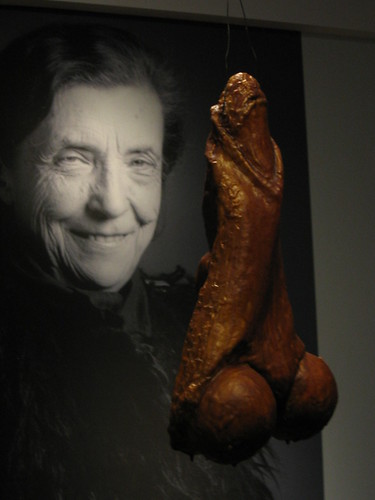
To convey her thoughts effectively through her art, Louise relied on sculpting as a medium and used a variety of materials such as “rubber, wood, fabric…metal…glass, paper, cement, and marble” (Crone, 1998). By creating sculptures, rather than painting, Louise was able to create physical manifestations of her thoughts and feelings in ways that ink and a canvas could not. Some were obviously reminiscent of her childhood and were not directly political statements, but the sculptures were still an effective method in portraying her traumatic memories nonetheless. Examples of this are Seven in Bed and Couple which blatantly depict her father’s daily activities while Les Mains/The Welcoming Hands is a bit more subtle, but still probably refers to her father when she was a child. Some of her other sculptures were much more symbolic and really stirred the societal pot and got people talking about them. One such example of this is her sculpture Fillette (1968) which is, as one critic would describe it, “a big, suspended decaying phallus, definitely on the rough side” (Chadwick, 340). Louise’s decision, as a woman, to create a decaying phallus in the artistic world of men was bold to say the least. By making a phallus with her own hands Louise symbolically demonstrates a woman’s power over a man while, at the same time, satisfying her own curiosity in regards to holding the object that gave her father (and all other males) the “power as a male” to do whatever he wanted to do. It was at this point that Fillette, and the culmination of all of her previous pieces, “became a rallying point for many younger women artists” (Chadwick, 340) and helped to make a push for the acknowledgement of women in the field of art and society in general.  Some of these women who rallied behind Louise and were greatly influenced by her work are Eva Hesse, Lynda Benglis and Sophie Calle- all sculptors who explored the ideas of feminism, the body, and identity.
Fillette, 1968 Louise Bourgeois

Les Mains/The Welcoming Hands, 1996 Louise Bourgeois


        Louise Bourgeois’ work, although it is quite obvious now, was “recognized only in retrospect…as a metaphor for gender (in politics and society)” (Chadwick, 324). Yes, there is the possibility that her some of her pieces may only be sentimentally significant to her and that they might not have been created with the intent to stir up a debate- but the situations depicted her sculptures were so relatable to other women in society that Louise managed to pave the way for other courageous female artists to follow suit. Louise’s art not only challenged the standard of art in the 20th century, but it still manages to stand out even to this day. Not many females have ever sculpted and displayed as vivid of a phallus prior to Louise and I doubt that anyone in today's  society would have the “balls” to do it today. Louise Bourgeois has not only managed to successfully tell story of her own life through her sculptures, but she has told the stories of many other women too- standing as a pinnacle of feminine strength within a society still largely dominated by men.


Works Cited

art21. "Louise Bourgeois." PBS, 2012. Web.
         <http://www.pbs.org/art21/artists/louise-bourgeois>.
The Art Story. "Louise Bourgeois." The Art Story Foundation, 2013. Web.                                              <http://www.theartstory.org/artist-bourgeois-louise.htm>.
Crone, Rainer, and Petrus G. Schaesbe. Louise Bourgeois: The Secret of the Cells. Prestel,             1998. Print.
Chadwick, Whitney. Women, Art, and Society. 4th. New York: Thames & Hudson, 2007. Print.

Wednesday, November 6, 2013

Frida Kahlo: The Pain and Passion

     Frida Kahlo was born in July 6, 1907. She was a Mexican painter, who was most famous for her self-portraits. On September 17, 1925 Kahlo was riding in a bus that collided with a trolley car. She was seriously injured and was on the verge of dying, but she miraculously lived. She had a broken spinal column, a broken pelvis, and many other injuries. She spent three months in a full body cast where she suffered with pain and frustration. In 1927, she met Diego Rivera, who was a big influence in her painting career. Frida had always admired Diego and his work and eventually fell in love with him. Diego was impressed with her work and provided her with many insights of her art work. Diego eventually ended up cheating on Frida with her own sister and was devastated because she was close to her.
     Frida Kahlo was inspired by the symbolic monkeys because they were a symbol of lust, but Kahlo portrayed them as tender and protective. She used a lot of bright colors in her paintings and dramatic symbolism and primitive style. Since Frida was unable to use her body and function, she was never able to have a child, which was hard for her because every woman's wish is to have a child. She never fully recovered, which explains why her self portraits displayed pain and anger. Her work is remembered for its "pain and passion." You can learn more about Frida's life here. She paints about the events that happened in her life, love, loss, politics, and surgery.


Frida Kahlo "My Birth" 1932
    Frida was not close to her mother as much as her father. Her mother, Matilde Calderon  y Gonzalez, was a Roman Catholic who was very religious. Her father, Guillermo Kahlo, was born in 1871. She was the closest to her father and believed that he was the only man she could look up to. In her painting, "My Birth" it shows Frida, herself being born, but her mother's face is covered with the sheet. This symbolizes that she was not close to her mother and she always felt distant towards her.

Frida Kahlo "The Flying Bed" 1932
    Frida Kahlo suffered a lot of pain in her life. She couldn't have a child, she couldnt move and function like normal human beings, and she was heart broken by the one man she truly loved and trusted. "The Flying Bed" represents events that happened in her life that caused her to feel pain and anger. You can see that there is blood on the bed which symbolizes the fact that she cannot have a child. It is heartbreaking and touching to see this painting because you can feel the suffering and pain Frida went through. Her struggles in life portrays how strong she was as a woman to be able to live on and go through this pain.  "The world just loves women artists who are sad and dead. But I was the hero of my own life" (Guerilla Girls, 79).

Frida Kahlo "The Broken Column" 1944

Frida Kahlo "The Two Fridas" 1939
                                 
    Frida's love for Diego Rivera was unconditional. She was truly inspired by his works, since he was already a painter, and she believed that he was her inspiration towards her paintings. Her pain mainly came from Diego after numerous affairs and the affair with her own sister. "The Broken Column" reveals nails stabbed onto her body but the biggest nail is stabbed right in her heart. This symbolizes her broken heart from Diego. "The Two Fridas" depicts that one of them is for the love towards Diego and the other is the hatred towards him. The open heart symbolizes this and the pain in their relationship.


Bibliography:

The Guerilla Girls. The Guerilla Girls' Bedside Companion to the History of Western Art. Penguin Books 1988
www.fridakahlo.com
Photo credit: Google Images


Post 3: 20th Century Artist: Hannah Hoch

HANNAH HOCH (November 1, 1889 - May 31, 1978)

Hannah Hoch


Anna Therese Johanne Hoch, also known as Hannah Hoch, was born on November 1, 1889, in Gotha, Germany. She is the eldest of five children and grew up in a small town bourgeois environment. She enrolled in the School of Applied Arts in Berlin-Charlottenburg where she studied glass design. Later she enrolled at the School of the Royal Museum of Applied Arts  and studied a graphic arts class. During her time in college in 1915, she had a relationship and artistic partnership with Raoul Hausmann, a Viennese Artist. Through him, she became part of the Berlin Club Dada in which she showed nine works at the infamous First International Dada Faoir in 1920, one includes the Cut With the Kitchen Knife Dada Through the Last Weimar Beer-Belly Cultural Epoch of Germany (1919-1920) [shown below]. This piece combines images from newspapers of the time re-created to make a new statement about life and art in the Dada movement.
Hannah Hoch, Cut With the Kitchen Knife
Through the Last  Weimar Beer-Belly Culture, 1919


The Berlin Club Dada was an artistic movement that also involved political radicalism. Dadaists were self-proclaimed radical thinkers who championed women's rights. Hoch was the only female Berlin Dadaist, therefore, was marginalized for her independent spirit, masculine dress, and bisexuality. She also expressed herself less politically than the others in the group. Her art works often confronted gender issues and depicted how she was against pro war societal issues.

Hannah Hoch's relationship with Hausmann didn't last, however.  He though that women were only good for support and childbirth. Hoch was against that proposal, therefore, she ended their relationship in 1922. She took all the negativity in her life and used it to strengthen her work in the future.  She experimented with non-objective art through painting, collage, photography and graphics.  She pieced them together and worked with a style that would later become known as photomontage. She mainly centered her work on women as they are depicted in media in comparison to actuality. She also created many pieces combing males and females.  She did this by extracting pictures of women’s bodies then detaching the body parts and replacing them with what she thought society wants in terms of the male society.  Her complex imagery expressed her oppressed broken life in a patriarchal society in pre-war and post war Germany.
Hannah Hoch, Da Dandy, 1919

Through her Montages of women she became known as discovering the "New Woman". The "New Women" were independent modern female, free to smoke, wear sexy clothes, vote and work (Guerrilla Girls, 66).  Hoch created a pathway for women in society and art; she even explored her own sexuality in her art. She was bisexual, although it was looked down upon at that time. She had a relationship with Til Burgman. This relationship also influenced Hoch's artwork because the photomontages would now contain same sex couples.  The Nazi's took over and were not fond of the relationship, so she was forced to end it and start a new one with a younger man whom she eventually married. She also had to hide her dada artwork because it was not acceptable during this time of war. Her artwork wasn't displayed until the war was over(Guerrilla 67).
Hannah Hoch and Til Brugman 1947
Hannah Hoch was and is a major influence in pop culture today because she helped create an art that is artistically cluttered and chaotic. She displayed an urge for women's rights through her art by  taking the societal norms of women and destroyed it, then rearranged it on a canvas of how she thought life was and how it was playing out. She also influenced the collages we make out of magazines today. She also influenced the idea of combining different images together that we can do using Photoshop.

She died May 31, 1978.


Bibliography:

The Guerrilla Girls. The Gurrilla Girls' Bedside Companion to the History of Western Art. New Yok: Penguin Books, 1998. Print.

Chadwick, Whitney. Women, Art, and society. forth edition. Londen: Thames and Hudson. 2007. Print.

http://www.nga.gov/exhibitions/2006/dada/artists/hoch.shtm
http://nmwa.org/explore/artist-profiles/hannah-h%C3%B6ch
http://chewonstyrofoam.wordpress.com/biography-of-hannah-hoch/
http://womenshistory.about.com/od/artpainting/a/hannah_hoch.htm

20th Century Artist..Augusta Savage

Augusta Christine Fells also known as Augusta Savage was an African American sculptor. She was born in Florida, and died in Harlem in the 1960's. Augusta was one of many great African American artist working for what she loved, and she fought for a cause. While, she was a sculptor, mother, feminist, visualist, and a teacher. She was born into a world where women were deemed inferior, or just an object may I add not just in the art world. Savage came into a world where African Americans were not equal, and didn't have the same rights as others. Two fold; she had to fight because she was a woman, and she had to fight because she was an African American woman artist. "Among ourselves, we encouraged each other but beyond that, it was another story." (Guerrilla Girls pg. 76)

In the picture Augusta Savage was sculpting, as photographed in 1935-1947 compilation of "Negro Art Exhibits, Workshops and Demonstrations."


While, the art world was already a struggle for a women to perform her art among her male counterparts, the race card made the struggle harder for black women. Savage was a fighter, and she wanted equality for not only her, but other African Americans as well. Savage became part of the Harlem Renaissance known as the "New Negro Movement." The Harlem Renaissance was not a movement solely for black artist, but for black people in general. Regardless, if you were an artist or a writer the movement was all for equality, and pushing forward towards the endeavors of African Americans. While, the movement lasted for some years its ideas planted seeds that has flourished among the African American race. The Harlem Renaissance harvest around the same time of the 19th Amendment. The 19th Amendment granted Women Suffrage for women like Savage, but the fight continued on. While, the 19th Amendment was suppose to stand for suffrage African American women remained at the bottom of the totem pole, well at least in some folks eyes.

The WPA (The Works Progress Administration) supported the progress of women art, but not all women. Augusta Savage in that moment became a suffragist and she lobbied to gain the same rights as other women who had access to the WPA. Savage brave attempts not only got the job done, but she later became an instructor for the WPA. How about those apples! Hard work did pay off for Savage in that aspect. Savage became an important figure in Harlem as she supported the Harlem Community to the fullest extent.
Augusta sculpture "Lift Every Voice and Sing" 1939. One of her best sculptors which depicts freedom.


Augusta believed in training younger African American artist. She supported the Harlem Community Art Center which shifted to a gallery called The Salon of Contemporary Negro Art. While, she faced a racial scandal involving the French government where she was denied a summer program outside of Paris she didn't give up the fight, and she continued on her journey. She help to start the Harlem Arts Guild and the Vanguard Club. Savage opened up a school named the Savage Studio of Arts and Crafts. Although, she ran into brick walls Savage continue to find ways around the walls placed in front of her. All in all, to endure hardships the fight becomes tired after a while. "I attended  Cooper Union, which was free and at the age of twenty-nine I was given a special stipend for living expenses. But my dream was to study in France. I heard about a summer program for women, so I applied, only to be rejected when white girls, much less qualified, were chosen." (Guerrilla Girls pg. 76)

Augusta was seven out of fourteen children. While, she became a leading figure among her counterparts she worked with prominent people in Harlem. She was for her people, and for equality all around the board. She touched base on racial identity, and she worked with bust. Savage started using red soil clay as a little girl, which is a driving force in her art. She uses a few mediums such as marble, clay, sand and soap. Savage has influenced many contemporary artist like Faith Ringgold, and Lorna Simpson. Simpson along with Ringgold both are African American artist who talks about race and society. While, all three ladies did art differently they relate in their story of activism and sexism.

Bibliography:

Chadwick, Whitney. Women, Art and Society. London: Thames and Hudson 2002.

Guerrilla Girls. The Guerrilla Girls Bedside Companion to the History of Western Art. New York: Penguin 1998.

"Augusta Savage." 2013 The Biography Channel Website, 2013.

"Augusta Savage." Encyclopedia Britannica. Encyclopedia  Britannica Online.

Images From:
www.mutualart.com
http://en.wikipedia.org